
By Chef Ahmad | CookDawn
🔥 The Sizzle You Hear — And the Sauce You Keep Ruining
The smell hits you before you even open the pan.
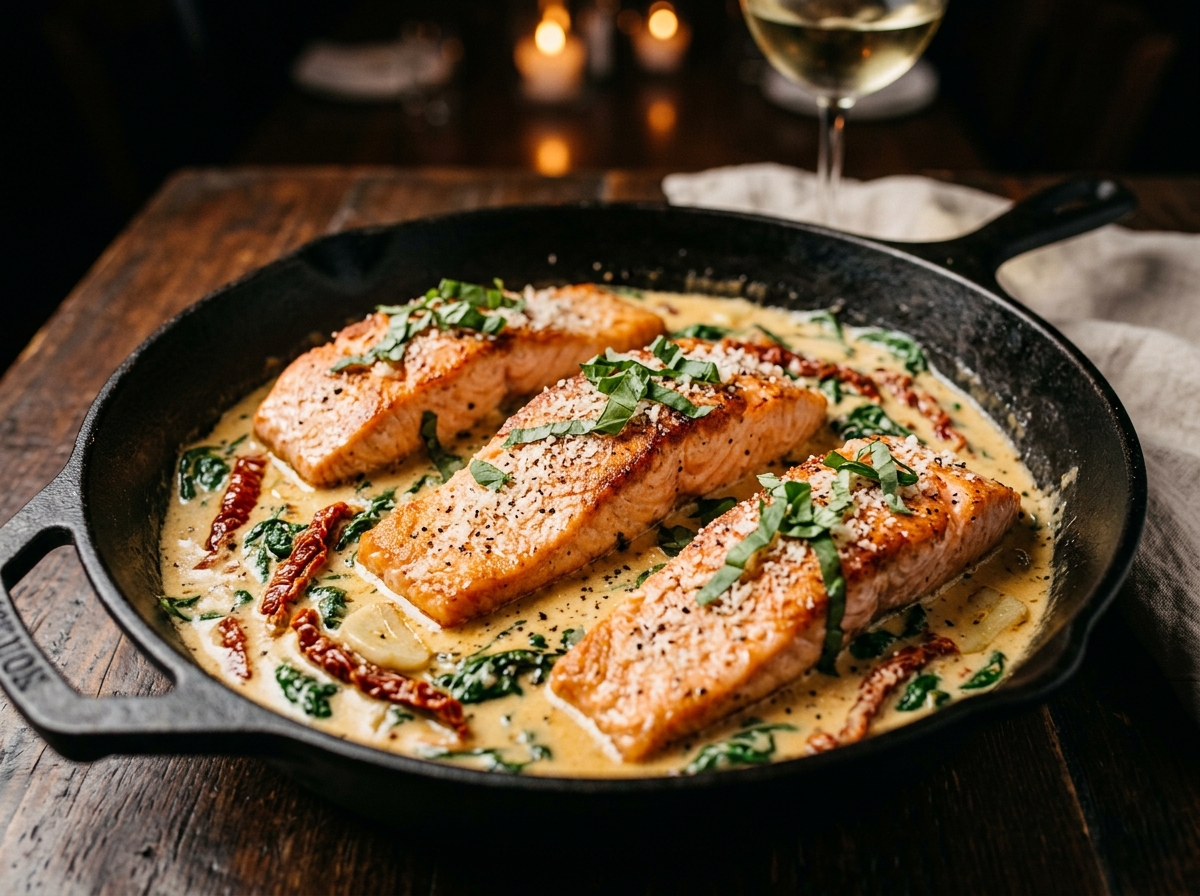
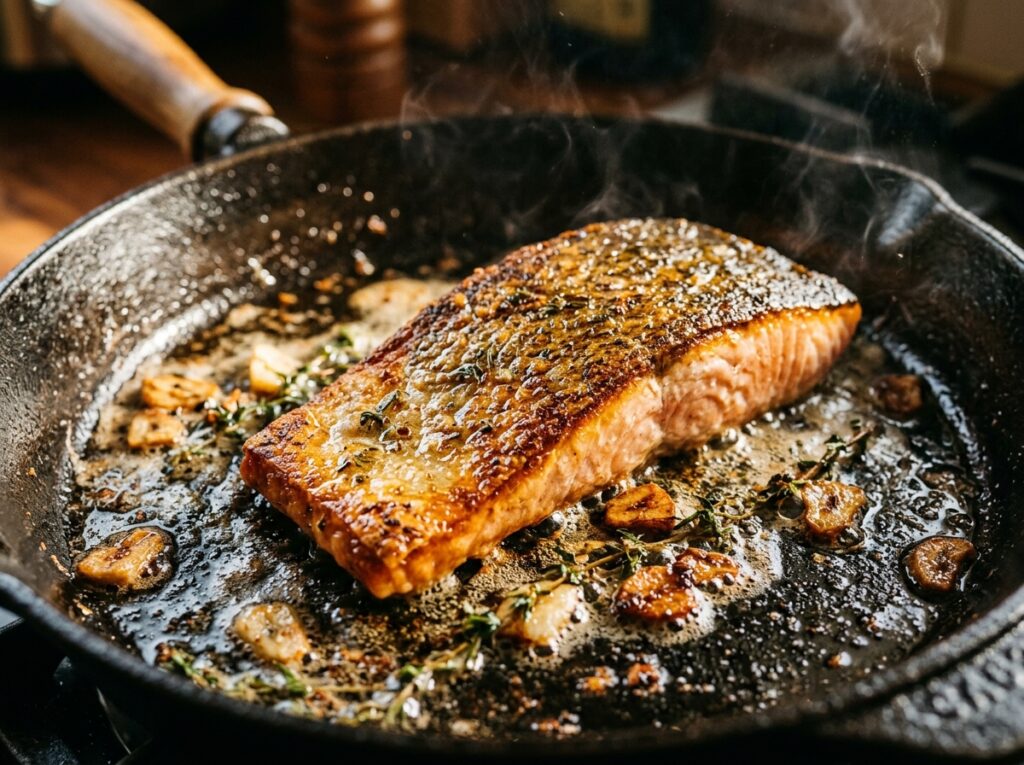
That first aggressive sizzle when a cold salmon fillet meets a butter-slicked skillet running at the right temperature — it is not just sound. It is the beginning of something. The skin crisps and pulls away from the pan in a slow, golden retreat. The flesh turns from translucent to that perfect coral-pink opacity. And then you pour in the cream.
And then it breaks.
If you have made Creamy Tuscan Salmon before and ended up staring at a greasy, separated, oily mess instead of a silky, restaurant-quality sauce — you are not a bad cook. You are a cook who was never told why it happens. Because this dish fails at the chemistry level long before it fails at the technique level.
I have tested this recipe across dozens of batches in different pans, at different temperatures, with different fat percentages in the cream. I adjusted one variable at a time until the sauce held every single time. What I found changed the way I teach this dish entirely. The secret is not a special ingredient — it is understanding what emulsification actually is and what destroys it.
Give me twenty minutes and I will give you the most reliable, deeply flavorful Creamy Tuscan Salmon you have ever made at home.
🧪 The Science Behind the Sauce — Why Fat and Water Are Natural Enemies
Let us talk about what is actually happening inside that pan, because this is where most recipes completely abandon you.
Emulsification is the process of forcing two liquids that naturally repel each other — in this case, fat and water — into a stable, unified mixture. Heavy cream is already a partial emulsion. The fat globules in cream are suspended in water and held in place by naturally occurring phospholipid molecules called casein proteins, which act as emulsifiers. They have one water-loving end and one fat-loving end, so they sit at the boundary between fat and water droplets and keep everything together.
This works beautifully — until heat destabilizes it.
When cream gets too hot, those protein structures begin to denature and lose their shape. The fat globules they were holding in suspension start to coalesce and pool together. The water phase separates out. What you see in the pan is a greasy, broken, oily liquid that no amount of stirring will fix, because the emulsion has physically collapsed.
The temperature relationship that governs sauce stability can be expressed simply:
ΔGemulsion=ΔH−TΔS
In simple terms: as temperature T increases beyond the stability threshold of your emulsion, the system becomes thermodynamically unfavorable — meaning the emulsion wants to break. The cream does not fail because you did something wrong in the moment. It fails because the system reached a point where separation requires less energy than staying together. Your job as the cook is to keep temperature below that threshold.
That threshold for heavy cream sauce is approximately 180°F / 82°C — a gentle simmer. The moment your sauce hits a rolling boil (212°F / 100°C), you have crossed the line. The emulsion will collapse, and there is no saving it.
The fix is not a rescue technique. The fix is temperature control from the start.
The Maillard Reaction on That Salmon Skin
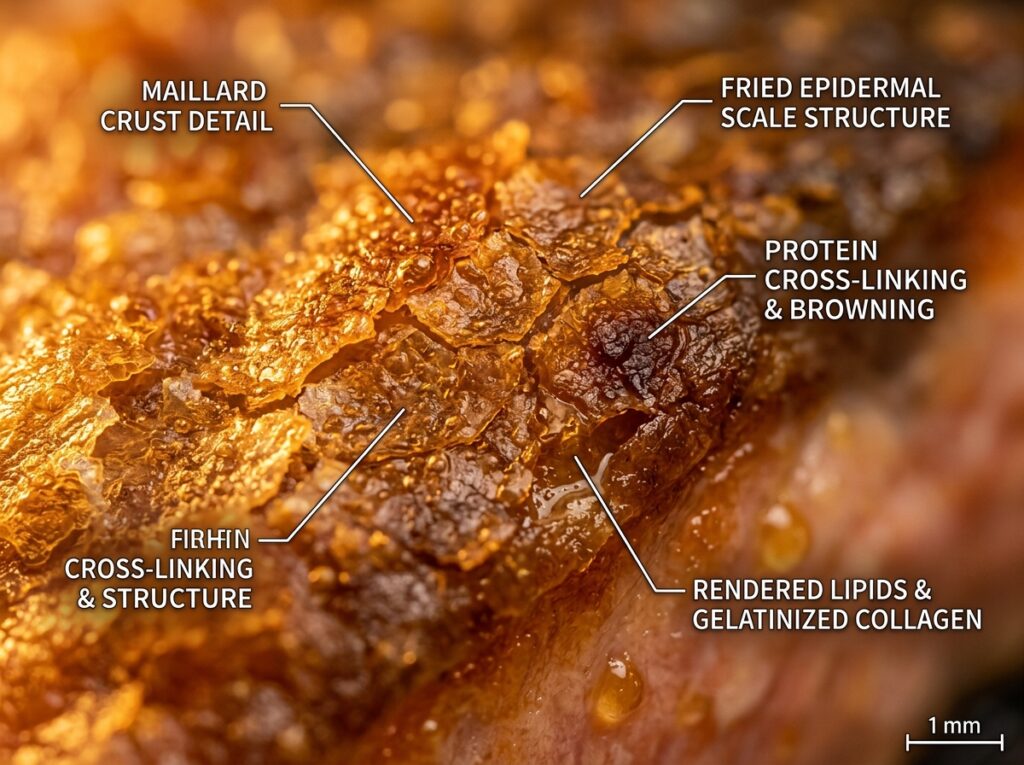
Before we even get to the sauce, the sear matters enormously. Salmon skin is rich in proteins and trace sugars, and when it contacts a surface running at 375–400°F / 190–204°C, the Maillard Reaction ignites — the same amino acid and reducing sugar reaction that creates the crust on a smash burger or the bark on a brisket.
The result is not just visual. The Maillard Reaction produces hundreds of new aromatic compounds that were not present in the raw fish — deep, savory, slightly nutty flavors that the cream sauce will pick up and carry throughout the dish. A properly seared salmon fillet contributes more flavor to this dish than any herb or seasoning you add.
A pale, gray, steamed salmon fillet adds almost nothing. It just exists inside the sauce, contributing texture and protein but no depth.
Sear first. Sear properly. Everything else follows.
🛒 Pro Buying Guide — USA Market Picks
The Salmon: For this recipe, Atlantic salmon is the most forgiving option — its higher fat content keeps it moist even if you cook slightly past target. Look for Verlasso Sustainable Atlantic Salmon at Whole Foods, or the Wild Alaskan Sockeye at Trader Joe’s if you want a leaner, more intense-flavored option. Walmart’s Great Value Atlantic Salmon fillets are consistently reliable for a budget-conscious pick. Buy skin-on fillets whenever possible — the skin protects the flesh during the sear and releases collagen into the sauce.
The Cream: Use heavy whipping cream with 36% fat or higher. In the USA, Organic Valley Heavy Whipping Cream (available at Whole Foods and Kroger) and Horizon Organic (at Target and Walmart) are the most stable options for sauce work. Lower-fat “light cream” or half-and-half will break faster and will not hold the emulsion under restaurant-level heat.
The Butter: Kerrygold Unsalted Irish Butter is my consistent recommendation — its higher butterfat content (84% vs the standard 80%) gives the sauce a silkier, richer body. Available at Trader Joe’s, Kroger, Target, and Walmart nationwide.
Sun-Dried Tomatoes: Look for Bella Sun Luci Sun-Dried Tomatoes in Olive Oil — available at Costco and most major grocery chains. The oil they are packed in is flavorful and can be used as part of your cooking fat for extra depth.
The Pan: A 12-inch stainless steel skillet or Lodge cast iron pan is ideal. Non-stick surfaces do not hold enough heat to properly sear salmon skin. The All-Clad D3 Stainless 12-inch skillet (around $100 at Williams Sonoma or Amazon) is the professional benchmark. For budget picks, the Cuisinart MultiClad Pro at around $50 performs nearly as well.
📋 Ingredients Table
| Ingredient | US Customary | Metric |
|---|---|---|
| Salmon fillets (skin-on) | 4 fillets, 6 oz each | 4 fillets, 170g each |
| Unsalted butter (Kerrygold) | 3 tbsp | 42g |
| Olive oil | 1 tbsp | 15ml |
| Garlic cloves, minced | 5 cloves | 5 cloves |
| Heavy whipping cream (36%+) | 1 cup | 240ml |
| Chicken broth (low sodium) | ½ cup | 120ml |
| Sun-dried tomatoes (in oil), sliced | ⅓ cup | 55g |
| Fresh baby spinach | 2 cups, packed | 60g |
| Parmesan, freshly grated | ⅓ cup | 35g |
| Fresh lemon juice | 1 tbsp | 15ml |
| Lemon zest | 1 tsp | 2g |
| Italian seasoning | 1 tsp | 3g |
| Red pepper flakes | ¼ tsp | 0.5g |
| Kosher salt | 1 tsp | 6g |
| Black pepper, coarse | ½ tsp | 2g |
| Fresh basil, for garnish | Small handful | Small handful |
❌ Why Most People Fail This Recipe
This section exists because most Creamy Tuscan Salmon recipes give you the steps but skip the reasons. Here is where things go wrong — and why.
| The Mistake | What Actually Happens | The Fix |
|---|---|---|
| Cold salmon straight from fridge to pan | Uneven cook — outside overcooks before center reaches temp | Rest salmon at room temp 15 minutes before cooking |
| Pan not hot enough before adding salmon | Fish steams instead of sears, skin sticks, no Maillard crust | Preheat pan until butter begins to foam and just turns golden |
| Moving the salmon during the sear | Crust tears, fish sticks, you lose the entire golden skin | Leave it completely undisturbed for 4 minutes — trust the heat |
| Boiling the cream sauce | Emulsion breaks, fat separates, oily greasy sauce | Never exceed a gentle simmer — 180°F / 82°C maximum |
| Adding Parmesan to boiling liquid | Proteins in cheese seize and clump, sauce becomes grainy | Remove pan from heat or drop to lowest setting before adding Parmesan |
| Skipping the lemon juice | Sauce tastes flat and one-dimensional, fat feels heavy | Lemon acid brightens the fat, balances richness, and subtly stabilizes the emulsion |
| Using pre-shredded Parmesan | Anti-caking agents prevent smooth melting, grainy texture | Always grate fresh from the block — BelGioioso Parmesan at most US stores |
👨🍳 Step-by-Step Method
Step 1 — Prepare Your Salmon the Right Way
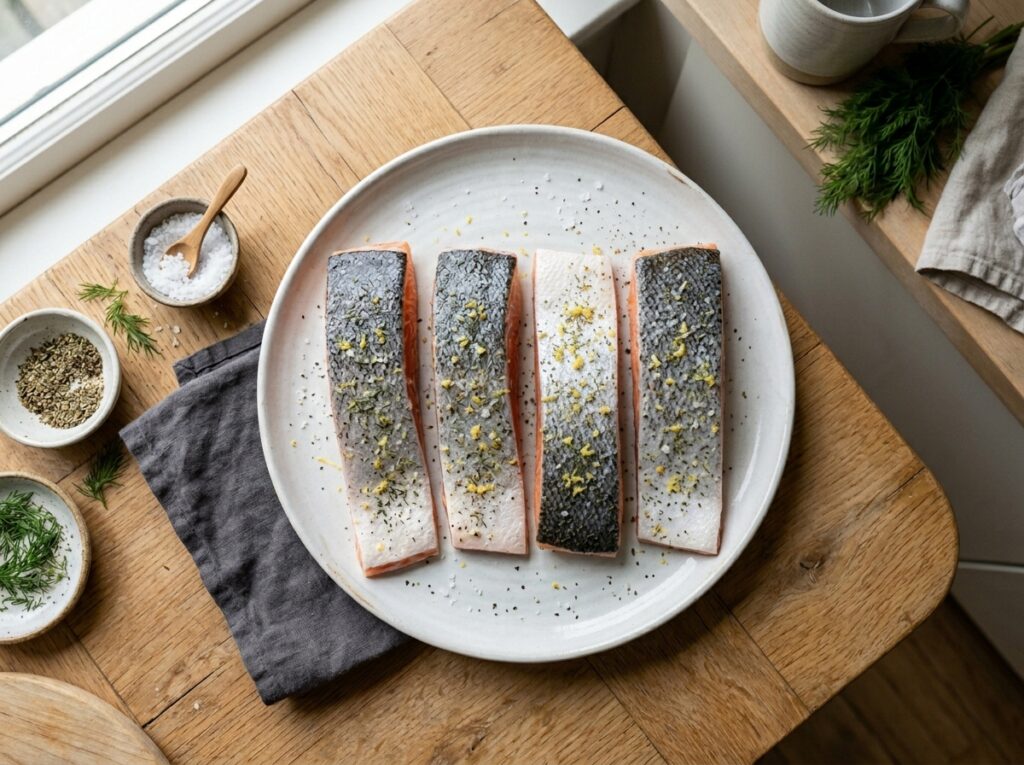
Remove your salmon fillets from the refrigerator at least 15 minutes before cooking. Pat every surface completely dry with paper towels — this is non-negotiable. Surface moisture is the enemy of the Maillard Reaction. Any water on that skin will create steam the moment it hits the pan, and steam lowers the effective surface temperature below what you need for browning.
Season both sides generously with kosher salt and coarse black pepper. Set aside on a plate while you heat your pan.
Step 2 — Build the Sear
Place your stainless steel or cast iron skillet over medium-high heat. Add 1 tablespoon of olive oil and 1 tablespoon of the butter. Watch the butter carefully — when the foam subsides and the butter just begins to take on the faintest golden color, your pan is ready. This is the sweet spot: hot enough for the Maillard Reaction, not so hot that the butter burns and turns acrid.
Place the salmon fillets skin-side down. Press them gently for the first 5 seconds with a spatula to ensure full skin contact with the pan. Then put the spatula down and walk away. Do not touch them for 4 full minutes.
Step 3 — The Flip and Finish
After 4 minutes, the skin should be deep golden and the flesh should have turned opaque about two-thirds of the way up the side. Slide a thin spatula under the skin — it should release cleanly with minimal resistance. Flip once, and cook the flesh side for just 2 more minutes. You are targeting an internal temperature of 145°F / 63°C per USDA guidelines.
Remove the salmon to a clean plate. Do not wipe the pan — those brown bits stuck to the bottom (the fond) are pure concentrated flavor that will dissolve into your sauce.
[📸 IMAGE PLACEHOLDER — Salmon being flipped in the skillet, golden skin revealed, fond visible on pan surface, dramatic kitchen lighting]
Step 4 — Build the Garlic Butter Base
Reduce heat to medium. Add the remaining 2 tablespoons of butter to the same pan. Add minced garlic and cook for exactly 60–90 seconds, stirring constantly. Garlic goes from perfectly golden to burned in seconds at this temperature, and burned garlic will make your entire sauce taste bitter. You want fragrant and just barely golden at the edges.
Add the sun-dried tomatoes and stir for 30 seconds. The oil they carry will deglaze the fond from the pan — you will see those brown bits lifting and dissolving. This is flavor transfer in real time.
Step 5 — The Sauce (This Is Where Control Matters)
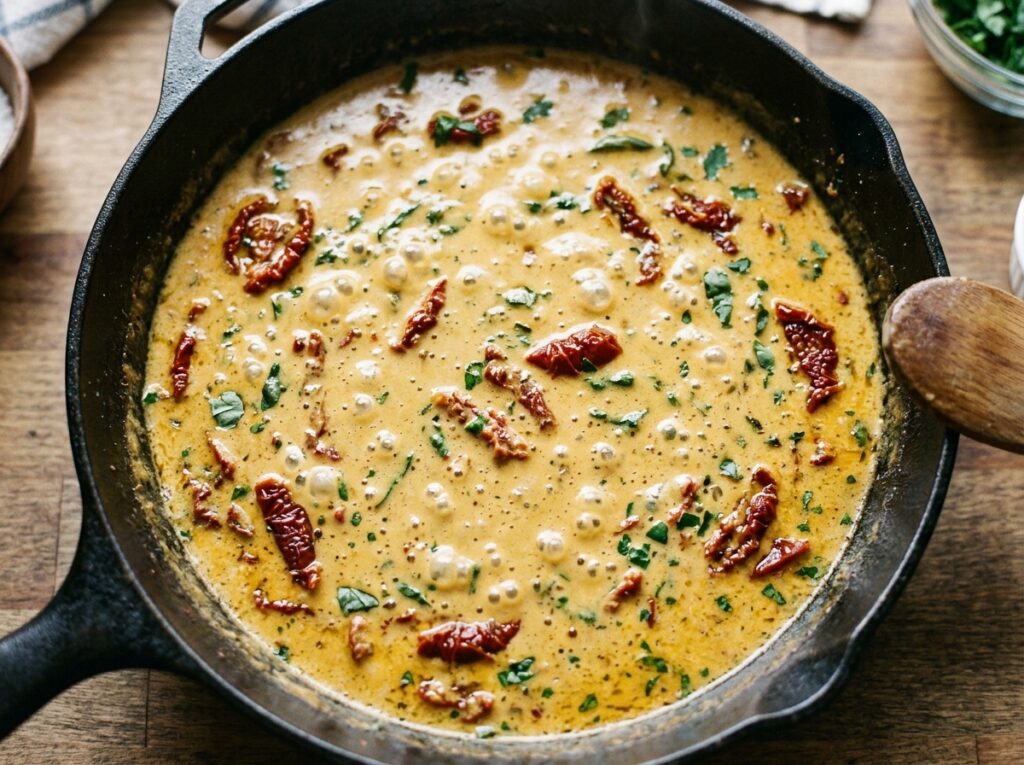
Pour in the chicken broth first and let it reduce by half — about 2 minutes. This concentrates the savory base before the cream enters. Now add the heavy cream. Stir gently and bring the sauce to a gentle simmer only — small bubbles breaking at the surface, not a rolling boil. This is your 180°F / 82°C target zone.
Let it simmer for 3–4 minutes, stirring occasionally, until the sauce reduces and coats the back of a spoon. If you see it approaching a boil, immediately reduce the heat. There is no recovering a broken emulsion once it separates.
Add the Italian seasoning, red pepper flakes, and lemon zest at this stage.
Step 6 — The Secret Stabilizer
Remove the pan from the heat entirely or drop it to the lowest possible setting. Add the freshly grated Parmesan in three small additions, stirring between each. The residual heat is enough to melt the cheese smoothly without causing the proteins to seize.
Now add the fresh lemon juice. This is the step most recipes skip, and it is the reason restaurant Tuscan salmon tastes brighter and more balanced than home versions. The acid in the lemon juice slightly lowers the pH of the sauce, which helps stabilize the fat-water interface and adds a lift that cuts through the richness without making the dish taste citrusy.
Add the baby spinach and stir until wilted — about 60 seconds.
Step 7 — Return the Salmon, Plate, Serve
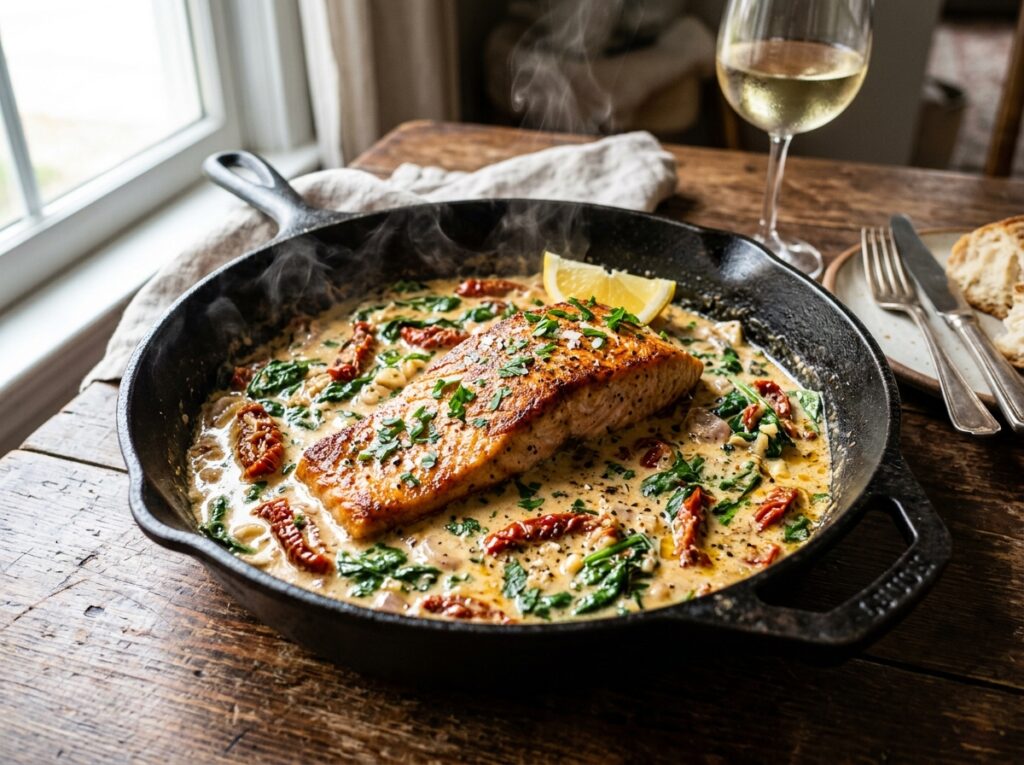
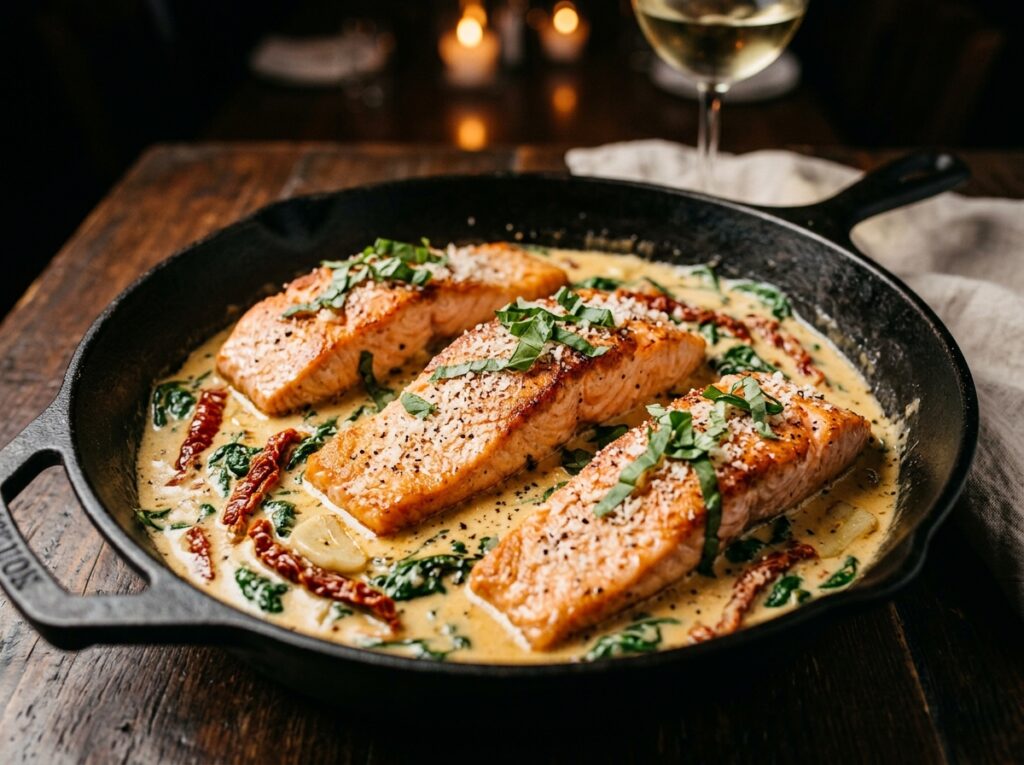
Nestle the salmon fillets back into the sauce, skin-side up to preserve the crust. Spoon the sauce over the top. Let it rest in the pan off the heat for 1 minute — this allows the residual heat to gently warm the salmon through without overcooking.
Garnish with fresh basil and an extra pinch of lemon zest. Serve immediately with toasted crusty bread to pull through the sauce, or alongside garlic mashed potatoes or roasted lemon asparagus.
💬 Chef Hamid’s Insight
Tuscan salmon is deceptively simple on the surface — and that is exactly what makes it challenging. You cannot hide behind complexity here. There is no twelve-hour braise masking a weak technique, no heavy spice rub covering a poorly seasoned protein. What you have is salmon, a pan, and a cream sauce, and every variable matters at every moment. I think about this dish whenever someone tells me that cooking is just instinct. Instinct without understanding will break your sauce the same way every time. But the moment you understand why the cream breaks, why the lemon matters, why the salmon must be dry before it touches the pan — the dish becomes reliable, repeatable, and genuinely yours.
The best technique is not the most complicated one. It is the one you understand well enough to trust.
— Chef Ahmad | The Flavor Bazaar
🥗 Nutrition Table
Per serving (1 salmon fillet with sauce). Values are estimates based on standard ingredients.
| Nutrient | Per Serving |
|---|---|
| Calories | 520 kcal |
| Protein | 42g |
| Total Fat | 36g |
| Saturated Fat | 18g |
| Carbohydrates | 8g |
| Sodium | 620mg |
| Cholesterol | 145mg |
| Omega-3 Fatty Acids | ~2,100mg |
Nutritional values are estimates. Actual values will vary based on salmon size, cream fat percentage, and brands used.
🌡️ Food Safety Temperature Guide
| Stage | Target Temperature | Notes |
|---|---|---|
| Salmon internal temp (USDA minimum) | 145°F / 63°C | Use instant-read thermometer at thickest point |
| Cream sauce maximum safe simmer | 180°F / 82°C | Above this, emulsion breaks and cream scorches |
| Pan surface for proper sear | 375–400°F / 190–204°C | Butter foam test is your visual indicator |
| Danger Zone | 40°F–140°F / 4°C–60°C | Never hold cooked salmon in this temperature range |
| Safe serving temperature | Above 140°F / 60°C | Serve immediately after finishing for food safety and best texture |
Always follow USDA food safety guidelines. The USDA recommends 145°F internal temperature for all fish.
🧊 Storage & Reheating Table
| State | Refrigerator | Freezer | Best Reheat Method |
|---|---|---|---|
| Cooked salmon with sauce | 2–3 days, airtight | Not recommended (cream sauce breaks on freeze/thaw) | Low heat in skillet, splash of cream, lid on, 5 min |
| Cooked salmon only (no sauce) | 3 days, airtight | Up to 2 months | Oven at 275°F / 135°C, 10–12 min, covered with foil |
| Cream sauce only | 2 days, airtight | Not recommended | Low heat, stir constantly, add 1 tbsp cream to re-emulsify |
| Raw salmon fillets | 1–2 days | Up to 3 months (vacuum sealed) | Thaw overnight in refrigerator — never at room temperature |
❓ FAQ
Why did my cream sauce turn grainy and separate?
Almost certainly a heat issue. The sauce either boiled when it should have simmered, or the Parmesan was added while the liquid was still at full heat. Pre-grated Parmesan with anti-caking agents is another common cause — the cellulose coating prevents smooth melting. Use a block of BelGioioso Parmesan and grate it yourself, add it off the heat, and keep your simmer gentle.
Can I make this without the sun-dried tomatoes?
Yes, but you will lose a significant amount of depth and acidity. If you do not have sun-dried tomatoes, substitute with a tablespoon of tomato paste browned in the butter for 60 seconds before adding the garlic. It will not be the same dish, but it maintains the savory-acidic balance the sauce needs.
What is the best salmon to use — wild-caught or farmed?
Both work for this recipe. Farmed Atlantic salmon has higher fat content, which makes it more forgiving if you slightly overcook it. Wild-caught Sockeye (available at Trader Joe’s year-round) has a deeper flavor and firmer texture, but it cooks faster and can dry out if you go even 30 seconds over. If you are new to cooking salmon, farmed Atlantic is more forgiving.
Can I use half-and-half instead of heavy cream?
I would strongly advise against it. Half-and-half has around 10–12% fat versus 36%+ in heavy cream. The emulsion is far less stable at lower fat concentrations, and you will almost certainly end up with a thin, broken sauce. If you want a lighter version, reduce the cream slightly and add more chicken broth for volume.
What should I serve this with?
This sauce was practically designed to be eaten with something that can absorb it. Garlic mashed potatoes are the classic American pairing — the starch carries the cream sauce beautifully. Roasted lemon asparagus adds a contrasting brightness and texture. Crusty sourdough bread for the table is never wrong. Avoid heavy pasta with this dish — the richness compounds too aggressively.
Leave a Reply